
AI governance is the practice of knowing what AI your organization uses, who is accountable for each use, what was decided about it, on what basis, and being able to prove all of that afterward. It is an operational discipline, not a policy document or a certification.
This guide covers what it means in practice, why it is harder than the frameworks suggest, how the EU and Japanese approaches differ, and how a small team can build a working program in ninety days.
The question that exposes the gap
Here is a scene that plays out in a lot of organizations, in some form, usually once.
A board member reads something on a plane and asks a simple question at the next meeting: how many AI systems are we running?
Four people answer. You get four numbers, and none of them is wrong.
One person counts licensed tools and says six. One counts active projects and says eleven. One counts models actually serving traffic in production and says two. One counts anything where a vendor used the word AI in a datasheet and says somewhere north of forty.
Everyone is answering honestly. They are answering different questions, because nobody has ever agreed what counts as one AI system.
That gap is the clearest statement of the problem I know, and everything below is about what it takes to close it.
A definition you can use on Monday
Look it up, and you will find something like: AI governance is the set of policies, processes, and controls by which an organization directs and oversees the development and use of artificial intelligence.
That is accurate. It is also hard to act on, because it describes the furniture rather than the job.
Here is the version I would defend in front of an auditor:
AI governance is the practice of being able to answer five questions about any AI in your organization, and show your working.
- What is it?
- Who owns it?
- What was decided about it?
- On what basis?
- Can you prove that, later, to someone who doesn’t trust you?
Everything else – policies, committees, frameworks, tooling – exists to make those five answerable. If a governance activity doesn’t move one of them forward, it is overhead.
The reason this framing earns its place is that it converts an abstract obligation into five concrete gaps you can go and measure this week. When teams try it, the common pattern is that question two is partially answerable, and question five is the one nobody has prepared for.
What AI governance is not
Clearing the ground saves a lot of argument later. Four things often get mistaken for AI governance. Each can play an important role, but none is sufficient on its own.
1. It is not a security review
The two overlap more than people expect. AI security covers data leakage, model misuse, prompt injection, and supply chain, and a good security review will surface governance-relevant facts. But they answer different questions.
Security asks whether the system can be compromised and how. Governance asks whether it should exist, who authorized it, on what evidence, and whether that authorization still holds. A well-secured system making unexplainable decisions about people is a security success and a governance failure.
2. It is not model evaluation
Benchmarks, red-teaming, and fairness testing produce evidence. Governance decides which evidence is required, who verifies it, when it expires, and what happens when it comes back bad.
Evaluation without governance is a folder of PDFs nobody reads.
3. It is not an ethics board
Committees decide hard cases. Governance is the system that routes hard cases to them and handles the large majority that aren’t hard.
If every AI use goes to the committee, the committee becomes a queue, and queues get routed around.
4. It is not a policy document
This is the most expensive confusion, because writing the policy feels like progress. It is entirely possible to spend a quarter producing an excellent AI acceptable-use policy while the number of ungoverned AI tools in the company keeps climbing. The policy can be genuinely good and still govern nothing, because nothing connects it to any actual system.
Why this is harder than the frameworks make it sound
Four structural problems cause most of the pain. They rarely appear in the literature, because they only show up once you try to build the thing.
1. You don’t know what you have, and finding out is its own discipline
Organizations consistently underestimate their AI footprint. Not because anyone is hiding anything – because AI arrived through a dozen doors at once. A feature switched on in a SaaS tool you already pay for. A developer’s personal subscription. A model endpoint spun up for a prototype that quietly became load-bearing. An agent framework someone installed over a weekend to try.
The first time you look properly, expect the number to be higher than your estimate, and plan for that emotionally. The instinct when the number comes back high is to argue with the number.
Two distinctions matter here, and collapsing either will hurt you later.
- A detection is not an asset. When your identity provider shows three hundred people authenticated to an AI service last month, that is a signal. It might mean one asset to govern, or five, or none. Treating every signal as an inventory record produces a register nobody trusts within a quarter. Treating signals as evidence about assets, stored separately, is slower to set up and correct permanently.
- Unrecognized is not unsafe. A tool you can’t identify is not thereby dangerous. It is unidentified. If your process treats “we don’t know what this is” as a risk finding, your team learns to stop looking – the opposite of what you wanted.
2. Tool approval and use approval are two different decisions
This one takes longer to accept than it should. Both levels are real, and you need both.
Tool-level governance asks whether the service is permitted at all. Is the vendor acceptable? Is the contract and data processing agreement in place? Is it configured for enterprise use – tenant isolation, retention settings, SSO, no training on your data? Is access controlled?
This is a decision at the service level, rather than a separate decision for every use case. It should be revisited when the vendor, contract, configuration, or other material conditions change.
On the other hand, use-case governance asks whether this particular use is appropriate given its data, purpose, autonomy, and impact.
The failure mode is treating the first as sufficient for the second. The support team summarizing customer tickets, the recruiting team drafting job descriptions, and the finance analyst pasting a contract in to find the termination clause may all be using the same approved tool.
Three different data exposures, three different groups of people affected, and in some jurisdictions three different legal classifications. One row with one risk rating averages things that should never have been averaged. It will be too strict for the job descriptions and far too loose for the contract.
So your inventory needs two linked things: the asset (tool, service, model, or agent) and the use case (who is doing what, with whose data, affecting whom).
Assets are largely discoverable. Use cases are mostly not. Signals can infer use – a finance team’s traffic to a contract-analysis endpoint tells you something real – but inference gives you a candidate, not a confirmed business purpose. Only a human can confirm purpose, intended outcome, and who is affected. That means a large share of your program cost goes into making the intake process easier to use than not using it.
3. Status collapses, and it collapses silently
Consider an inventory with a single field called Status. It will quietly end up carrying four different meanings:
- has this been discovered and confirmed to exist
- has it been approved for use
- is it currently running
- is it risky
Those are four independent facts. A tool can be confirmed to exist, approved last year, decommissioned in March, and still high risk because the data it processed is sitting in a vendor’s logs. A single field forces you to lose three of those, and every report built on it inherits the loss – which means you can produce a monthly governance report for a year before anyone notices it says nothing.
If you take one operational thing from this article, take this: separate your state axes before you have data in them. At minimum, keep discovery state, governance decision, lifecycle state, and risk apart. Retrofitting that separation after eighteen months of records is a migration project nobody wants to fund.
4. Approval is not permanent
The fourth problem follows directly from the third, and it is the one most likely to be designed out of a program entirely.
A use case approved for summarizing public information may need another look when someone starts feeding it customer data. A model update, a change in vendor terms, a new integration, or an agent gaining permission to take actions rather than suggest them can all change the risk without changing the tool’s name – which means nothing in your inventory looks different while the thing you approved has quietly become something else.
So governance has to record not only what was approved, but what changes should trigger another look. Decide early which attributes are material: data classification, affected population, autonomy level, external exposure, the model or vendor behind it, and the permissions it holds.
Then make a change to any of them to produce a reassessment rather than a silent drift. A register that only captures the decision, and never the conditions the decision depended on, will be accurate on the day it is written and wrong within a year.
The framework landscape, briefly
You will be told to adopt a framework. You should, eventually. It helps to know what each is for, because they are not alternatives to each other.
NIST AI Risk Management Framework gives you a structured vocabulary for understanding and managing AI risk, organized around Govern, Map, Measure, and Manage, and its companion Playbook offers suggested actions against each. What it cannot do – what none of them can do – is decide which controls make sense for your organization. Use it to structure how you talk about risk internally.
ISO/IEC 42001 is a management-system standard: roles, documentation, continual improvement, and you can be certified against it. If someone in your supply chain asks for a certificate, this is the one. It tells you how to run the machine, not what the machine should conclude.
The EU AI Act (Regulation (EU) 2024/1689) is law, with penalties, classifying systems by risk tier and by your role as provider or deployer. It is the only one of the three that will tell you something is prohibited outright.
Japan’s regime is a genuinely different model, covered next.
What none of them give you is the thing people most want: a way to decide whether this specific use is acceptable within your organization’s risk appetite. That is a judgment; it is yours, and the frameworks exist to make sure you make it deliberately and can show that you did.
Governing across hard law and soft law
Most English-language writing on AI governance is written from Brussels or Washington. I work from Japan, which means watching both models at once.
The EU runs hard law. The AI Act carries obligations and penalties, tiered by risk. Its timeline has moved, which is worth stating plainly because a lot of published guidance is now out of date.
The Digital Omnibus on AI (Regulation (EU) 2026/1744) was published in the Official Journal on 24 July 2026 and entered into force on 27 July 2026. It deferred the high-risk obligations for stand-alone Annex III systems to 2 December 2027, and for AI embedded in regulated products to 2 August 2028.
What did not move matters at least as much.
Article 50 transparency obligations began applying on 2 August 2026. One transitional exception is worth knowing: for certain providers of AI systems already placed on the market before 2 August 2026, the Article 50(2) requirements on marking and detecting synthetic content apply from 2 December 2026.
Article 4, the AI literacy duty, was rewritten but not removed. The original text, applicable since 2 February 2025, required providers and deployers to ensure a sufficient level of AI literacy. The amended text requires them to take measures to support the development of AI literacy among staff and others operating AI on their behalf, and adds explicitly that this does not require guaranteeing any specific level for any individual. In short: an obligation of effort rather than an obligation of result. It still binds, and it has bound since February 2025.
If you built a plan around “nothing bites until 2027,” check it.
Japan runs soft law, deliberately. The AI Promotion Act – formally the Act on Promotion of Research, Development, and Utilization of Artificial Intelligence-Related Technologies – was enacted on 28 May 2025, promulgated on 4 June 2025, and fully implemented on 1 September 2025. It is a framework law. It sets national direction and places effort-based and cooperation obligations on business operators. It carries no penalties for them.
For practical guidance, organizations can turn to the AI Guidelines for Business published by METI and MIC. These predate the AI Promotion Act, are principles-based, and do not themselves impose mandatory standards – they are independent, non-binding guidance rather than implementing regulations under the Act. Version 1.2, published on 31 March 2026, updates the guidance to address evolving AI applications, including AI agents and physical AI. Underneath both sits APPI for personal data, which is binding, and which is where most real enforcement exposure sits for a Japanese operation.
(Regulatory positions checked 31 October 2026. Both regimes move; verify against the primary texts.)
Three practical consequences, and they are not the obvious ones.
You cannot run two programs. The attempt produces two registers, two risk methods and two evidence sets, and the second one is always six months stale. What works is one program with one evidentiary standard, and a per-jurisdiction obligation set layered on top. Record-keeping is uniform. What you must do with the record varies.
Build to the stricter evidentiary standard, not the stricter rule set. These sound identical and aren’t. Do not impose EU high-risk conformity procedures on a Japanese internal tool that doesn’t need them; that is how governance programs become hated. Do keep records of the same quality everywhere, because good record-keeping is cheap and discovering you needed it retroactively is not.
In a soft-law jurisdiction, you have to justify the program internally. This is the real difference, and nobody warns you. In the EU, you can point at a regulation and a number.
In Japan, the AI Promotion Act doesn’t provide a direct financial penalty to point to, so you must make the business case on operational and commercial grounds. So, the case has to be won on operational and commercial grounds: customer due-diligence questionnaires, procurement requirements from EU counterparties, incident exposure, and the plain fact that you cannot manage what you cannot see. Import an EU-style fear-of-fines business case into a Japanese organization, and it will not land, and it will deserve not to.
One thing is the same in both places. When something goes wrong, you will be asked the same five questions. The absence of a penalty regime does not produce an absence of scrutiny. It moves the scrutiny from a regulator to a customer, a journalist, or your own board.
A minimum viable program in ninety days
Most practical guides offer a five-level maturity model. Few survive contact with a two-person team and no budget, which is what many organizations actually have.
Here is a smaller starting shape.
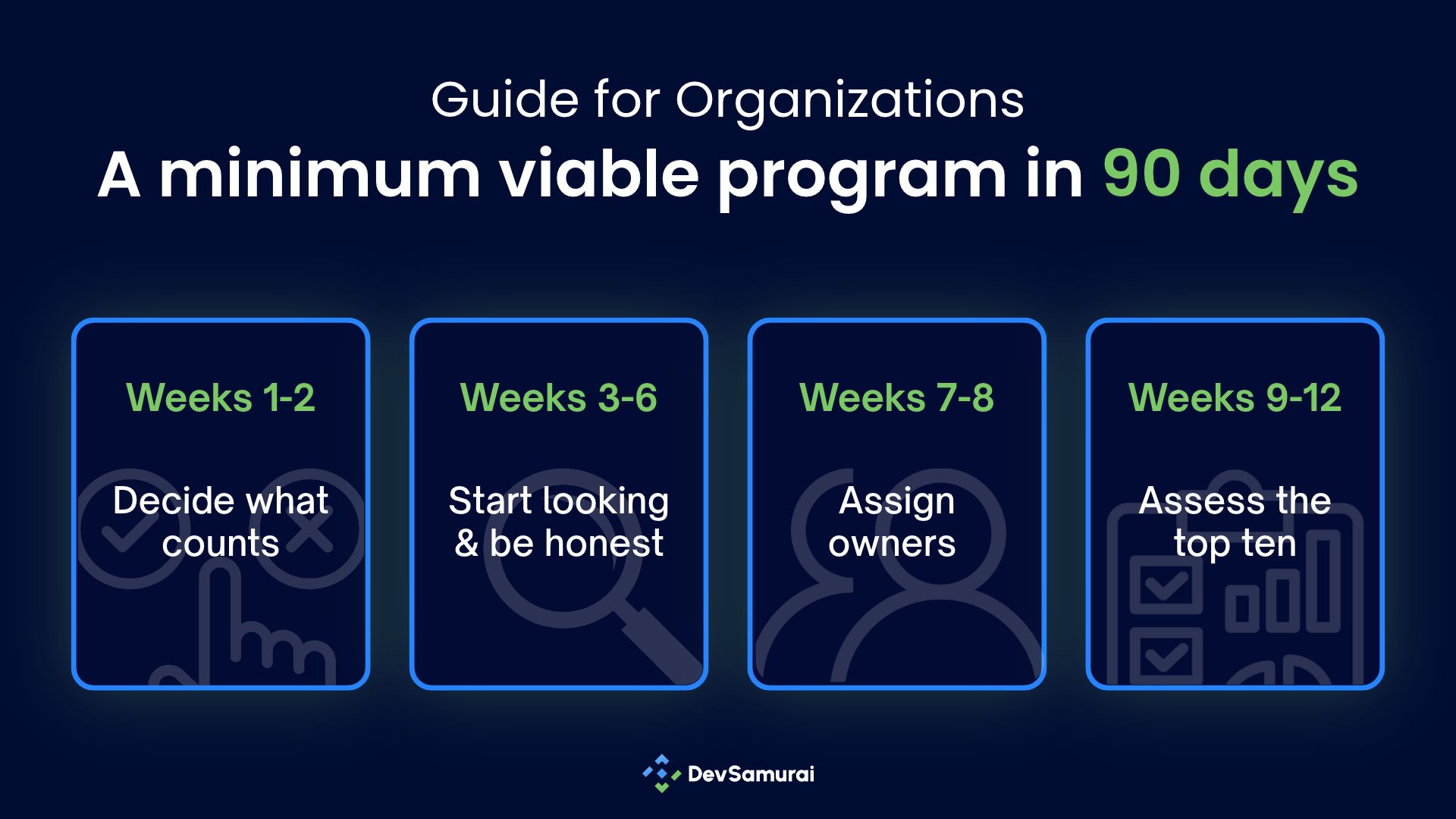
Weeks 1–2: decide what counts
In the beginning weeks, you should write one page defining what an AI use is for your organization, and more importantly, what it isn’t. Something like spell-check is out of scope. The recommendation engine in your product is in.
Get it agreed by whoever will later be annoyed by it. Everything downstream depends on this boundary, and arguing about it later costs far more.
Weeks 3–6: start looking, and be honest about what you can see
Start with your identity provider’s application list and your expense data. They are useful first sources, and they cost nothing, but neither gives you a complete picture. An identity provider cannot see AI accessed through personal accounts, direct API keys, or authentication outside your identity infrastructure. Expense data will miss free tools, AI switched on inside subscriptions you already pay for, and anything an employee funded personally.
Add your cloud provider’s AI service usage, and proxy or network logs where you have them and are permitted to use them. Treat everything you find as discovery signals, not as a finished inventory. Record findings with four separate columns for the four state axes, because you now know why.
Weeks 7–8: assign owners before assessing anything
An asset without a named accountable human can be inventoried but not governed. Expect a meaningful share of your list to have no obvious owner. That gap is itself the most actionable finding you will produce, and it is usually easier to fix than people fear. Assessing before assigning means your assessments land on nobody.
Weeks 9–12: assess the top ten, and record decisions properly
Not everything. The ten with the most sensitive data, the most autonomy, or the most people affected. For each, record the decision, the basis, the date, the decision-maker, and the supporting evidence – and, following from the point about permanence above, what would trigger a re-review. Three sentences per item is fine. What matters is that the decision and its basis are both written down, and that someone could reconstruct the reasoning in a year.
What to do with what you find
Discovery produces a pile of mixed findings, and the common failure is treating them all the same way. A simple triage table prevents that:
|
Finding |
Immediate action |
|---|---|
|
Recognized AI, preliminarily low-risk use |
Complete a lightweight screening, register the use, assign an owner, and record why no further assessment is currently required |
|
Unknown or unrecognized service |
Investigate and classify. Do not mark it unsafe by default |
|
No accountable owner |
Assign follow-up responsibility and a deadline. Track the gap as a metric |
|
Sensitive data or high-impact use |
Prioritize for assessment; apply interim safeguards while it waits |
|
Confirmed unacceptable use |
Restrict or escalate, and record the decision and its basis |
Two things this table is doing. It keeps discovery, investigation, risk assessment, and governance decisions distinct.
These are workflow activities, and they are not the same thing as the four state axes described earlier. Meanwhile, keeping both clear is what stops an investigation status from being read as a risk finding or an approval decision.
And the first row distinguishes a quick screening from a formal assessment: low risk is still a conclusion someone reached and wrote down, not an assumption you skipped past.
What not to do in the first ninety days: don’t write the forty-page policy, don’t buy a platform, and don’t let framework adoption become the first milestone. All three are reasonable later, and all three are ways of feeling productive while the actual list stays unknown.
If you already have a binding obligation – an EU AI Act duty, a customer contract, a sector regulator – that obviously takes precedence over this sequence; the point is not to let a voluntary framework rollout delay finding out what you are already running.
Measuring it without lying to yourself
Governance programs die of two things: nobody uses them, or their numbers turn out to be false. The second kills faster, because it takes your credibility with it.
The rule I would give anyone starting: always show the denominator.
Not “94% control coverage.” Instead: ten of eighteen applicable requirements have independently verified evidence; four further requirements are of unknown applicability and are excluded from the denominator entirely.
Longer, less impressive, and it survives contact with an auditor. The short version does not, because the first question will be “applicable to what?” – and if you can’t answer instantly, every other number you have presented becomes suspect in the same minute.
Three related traps:
- Coverage is not compliance. Having evidence for a control says nothing about whether the control works. Two different states, and conflating them is the most common dishonesty in governance reporting, usually unintentional.
- Available is not verified, and authentic is not current. A SOC 2 report in your evidence folder is available. Whether anyone checked that it covers the right scope is a second fact. Whether it still covers the current period is a third. Keep all three.
- A silent source is not a safe source. If your discovery connector stopped working in August, a September report showing no new AI is not good news. Build staleness into the face of every report, or you will eventually present an outage as an achievement.
Why I wouldn’t rely on a single AI risk score
A single composite risk score is tempting. One number, zero to a hundred, comparable across everything. It makes beautiful dashboards.
But picture a reviewer looking at a score of 71 and asking how it was calculated. If the answer requires hunting for a questionnaire, a set of weights, and several undocumented assumptions, that number isn’t doing the work you think it is. The problem usually isn’t the calculation. It’s the inability to explain what the number means to the person the decision affects.
What I’d do instead: keep the dimensions visible. Data sensitivity, decision impact, affected population, autonomy, external exposure, scale. Show the weights. Show which control mitigated which dimension. Let the composite exist if people want it, but never let it be the only thing on the screen.
If you cannot explain a score in ninety seconds to the person it affects, you do not have a risk model. You have a vibe with decimals.
What it costs
Most governance writing ignores this, which is part of why governance programs get resented.
Governance is latency. A two-week review on a two-day integration is not a control; it is a tax. Slow governance is one of the best ways to create Shadow AI: when approval takes longer than the work itself, people find another route, usually without telling you. It is not the only cause – unmanaged purchasing, personal subscriptions, and plain unawareness all contribute – but it is the one entirely within your control.
Which means the only workable design is tiered, and tiering requires accepting something uncomfortable: most AI in your organization should be governed lightly. A marketing team using an approved tool on public data, with no automated decisions and no personal data, should require only a short screening and registration, nothing else. Save real review capacity for autonomy, sensitive data, and decisions about people. A program that reviews everything equally reviews everything badly, and will be the second thing cut in a downturn.
The second cost is honesty about what you don’t know. Mature programs report their gaps. Immature ones report their coverage. Choosing the first makes your numbers look worse for about two quarters and makes them trustworthy permanently.
The Five-Question AI Governance Self-Assessment
Take it, use it, no attribution needed. Score your organization on each row this week, answering from what you can actually produce in an hour rather than from what you believe is true.
Score each question 0, 1, or 2:
|
Score |
Meaning |
|---|---|
|
0 |
Weak – you cannot produce a reliable answer |
|
1 |
Partial – an answer exists, but lacks completeness or supporting evidence |
|
2 |
Good – you can demonstrate the answer with records and evidence |
Ten is the maximum. This is an internal starting-point diagnostic, not a certified compliance or maturity rating, and it is worth repeating every quarter to see which way the numbers move.
|
Question |
A weak answer |
A good answer |
|---|---|---|
|
What is it? |
A number someone estimated in a meeting |
A list with an agreed scope definition, a date, and a stated method for how it was compiled |
|
Who owns it? |
“IT, probably” |
A named person per asset and per use case, with a known gap count you can quote |
|
What was decided? |
“It’s approved” |
A decision, a decision-maker, a date, the scope it applies to, and what would trigger a re-review |
|
On what basis? |
A risk rating with no visible method |
Named dimensions, visible weights, the assessment version used, and what would change the answer |
|
Can you prove it? |
A shared folder |
Evidence with a known source, a verification state and an expiry, plus a report whose denominator is stated |
If you score weakly on rows one and two, don’t start on rows three to five. The first two are prerequisites. Programs that start in the middle produce impressive documentation about systems that turn out not to exist.
Where to start on Monday
Open your identity provider, list every application anyone authenticated to in the last ninety days, and read it with your own eyes. You will probably find AI you didn’t know about, and you will certainly find the edges of what that source can see.
That list is not a governance program, and it is not a complete inventory. But it is the first honest answer to the first question, and the other four only make sense once you have it.
I work on AI governance software, so these are problems I think about constantly. This series is about sharing what I’ve learned trying to make governance practical, including what doesn’t work.
Next in the series: how to discover the AI your organization is already using, including the tools nobody formally approved.
Regulatory information checked 31 October 2026. This article is for educational purposes and does not constitute legal advice.